HALLOWEEN SPECIAL: SAVE € 100 EURO PER PERSON on your 2027 Italian adventure!

Laundry in the sun. A timeless habit.

Gianni Stanghellini, PhD in Geology
·Published 22 Jun 2021
Share

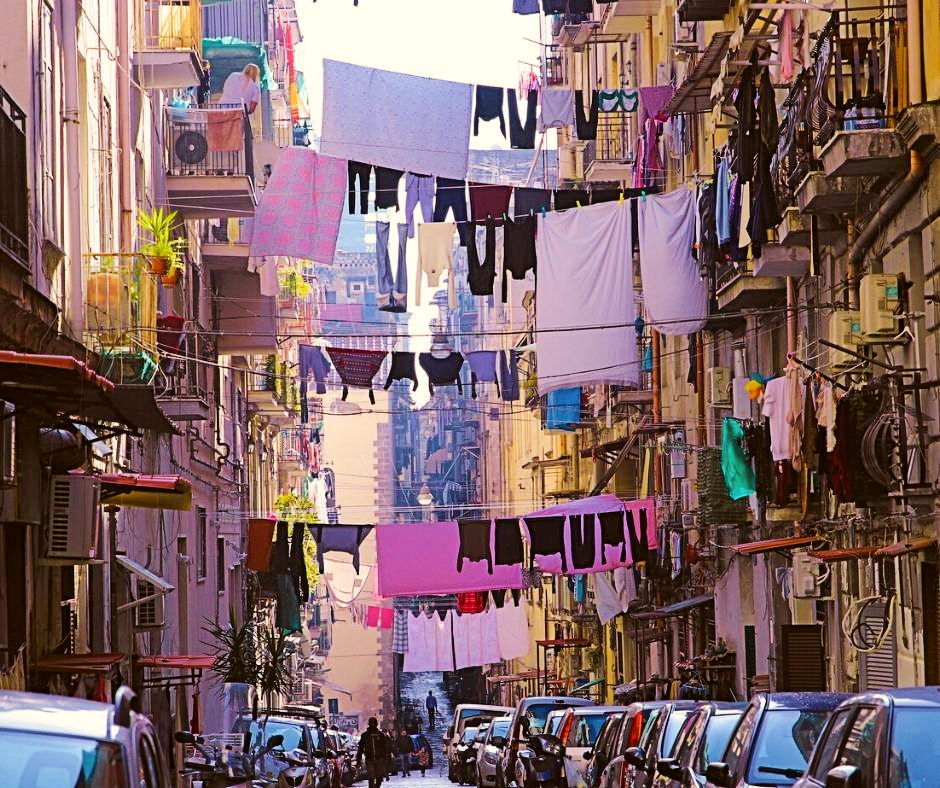
Clothes hanging on the drying racks of the balconies. Clothes hanging on ropes pulled under the windows or on the terraces. Clothes hung even in the narrow alleys on ropes suspended from one end of a house to the other.

They have been placed there in an accurate and well-studied way: all the laundry must enter that space and the organization of the drying rack (or of the rope!) becomes a true art. It is advisable to hang bulky clothes such as sheets or towels first, for t-shirts it is good to place the clothespins under the sleeves at the seams, if we are in winter (because the clothes hang outdoors even in winter!) it is better to choose days with dry cold etc…

It is not uncommon to hear conversations asking what the weather forecast for the next day is, to decide whether or not to do laundry. Today everything flows faster thanks to technology, but if we do not have a dryer in our home, the only thing to do to dry clothes … is to put them in the sun! And we are not always lucky. The tradition of making laundry has remained the same over the years: of course, we have efficient washing machines comfortably installed in the heat of our homes and we do not go to the fountains like our grandmothers did, but it is also true that to hang our clothes well washed and perfumed we must follow the climate, adapting to the rhythm of the seasons. Sometimes we get extremely nervous about the rainy or humid day, but we can’t do much about it: we will wear something else … because the one hanging from the rope has definitely not dried! It’s not that tragic, come on!

We are very familiar with the image of clothes hanging out to dry in the sun and in the wind, but sometimes I observe foreigners and see them with their noses up: intrigued, they observe and photograph those clothes that colour and “decorate” the facades and the streets of the city. But it’s not just colours. What is behind a laundry? A person’s life. The hanging clothes tell us many stories about those who look out on that balcony: their private lives take a step outside and mingle with many other private lives, sharing the freedom to hang out in the air.

Fun facts! In Italian referring to freshly washed clothes we speak of bucato (punctured). The term seems to derive from the container used when the clothes were still washed by hand. The clothes were boiled in water and ashes and then placed into the container which had a hole (buco) at the bottom closed with a cap. After about an hour the cap was removed from the hole to let the water flow: the clothes were now ready to be rinsed in the fountain.

written by Irene Testi,

tour assistant at Walk About Italy


Gianni StanghelliniPhD in Geology. Gianni Stanghellini is the founder of Walk About Italy and has been leading walking tours across Italy for over twenty years. A geologist by training, he reads the landscape differently — the shape of a valley, the colour of a cliff, the reason a village was built exactly where it was. Food, wine and the people who produce them are never far behind.

Share this story

To share on Facebook, tap its icon, then choose Facebook (or any other app) from the list that opens.

To share on Facebook, tap its icon, then choose Facebook (or any other app) from the list that opens.

More stories

Yellow May in Italy On the Trail

Yellow May in Italy

Spring has started for a couple of months now in Italy; the sun gives us long and warm days and nature has awakened! It is an explosion…

By Gianni Stanghellini
Get used to being amazed. Sicily, the beautiful. On the Trail
Secret Sicily

Get used to being amazed. Sicily, the beautiful.

Sailing with a boat on the crystal clear waters of the Tyrrhenian Sea,a few kilometers from the Sicilian coast, an island appears before us...or maybe two?…

By Gianni Stanghellini
The rest of the olive tree On the Trail

The rest of the olive tree

Winter is a period of rest for everyone,even for plants.  In winter plants reduce their physiological functions to a minimum: they slow down and wait patiently…

By Gianni Stanghellini
Get our stories in your inbox

A selection of our stories and news from the walks, now and then. No spam.

HALLOWEEN SPECIAL

No tricks, just treats!

Save €100 per person on your 2027 Italian adventure!

Use code HALLOW26 – Ends October 31

Days
Hours
Minutes

Walk rating guide

Terrain: Mostly flat or gently rolling terrain, with well-maintained paths and only occasional short uneven sections.
Distance: Usually shorter walks, around 4.5 to 5.5 km / 3 to 4 miles per day, depending on the itinerary.
Elevation gain: Very limited. There may be a few gentle slopes, but no significant climbs or descents.
Who it is for: Ideal for beginners, casual walkers, families, and anyone looking for a relaxed walking holiday with little physical effort.

Terrain: A mix of flat sections and more uneven ground, with some inclines, steps, or minor obstacles that remain manageable for most reasonably active travellers.
Distance: Generally around 5 to 8 km / 3 to 5 miles per day, depending on the tour and terrain.
Elevation gain: Noticeable but not demanding. Some uphill and downhill stretches may be present, though never steep or prolonged.
Who it is for: Suitable for beginners who want a slightly more active experience, as well as for regular walkers looking for a relaxed but rewarding pace.

Terrain: Varied terrain that may include uneven paths, longer walking sections, and regular uphill or downhill stretches.
Distance: Moderate daily walking time and distance, suitable for travellers who enjoy being active outdoors for a good part of the day.
Elevation gain: More consistent and clearly noticeable, though still within the reach of anyone with a basic to good level of fitness.
Who it is for: Best for active travellers who are comfortable walking for several hours a day and can handle some uneven terrain and sustained inclines.