
There is a flower that always makes me smile: the saffron crocus.
It looks almost too delicate for the job it has to do, with pale violet petals and three fine crimson stigmas, yet every autumn it manages to push its way through the hard clumps of Tuscan soil. Fragile in appearance, surprisingly stubborn in character — perhaps that is part of the reason I like it so much. And to think that saffron in Tuscany isn’t even that well known…
One of my favorite places to see saffron is Podere Santa Maria, a family farm in the countryside between Pienza and Monticchiello, in the heart of the Val d’Orcia. When our visit happens to coincide with the flowering season, the purple crocuses scattered across the fields turn something most of us know only as an expensive spice in a tiny jar into something wonderfully tangible.
Over the years, Maura and Virno have taught me a great deal about saffron, but visiting Santa Maria has also taught me something broader about farming in Tuscany. Behind those beautiful landscapes that visitors photograph are families, generations of work, changing seasons and a remarkable amount of patience. Saffron, with its three tiny red threads hidden inside each flower, tells that story particularly well.
Table of Contents
- Arriving at Santa Maria Farmhouse in the Val d’Orcia
- A farm where the whole family is involved
- How saffron grows
- From flower to spice: the autumn harvest
- Why saffron is so precious
- Maura’s kitchen, her recipe book and a dessert with a story
- Saffron beer: the unexpected finale
- Discovering saffron on our Iconic Tuscany tour
Arriving at Santa Maria Farmhouse in the Val d’Orcia
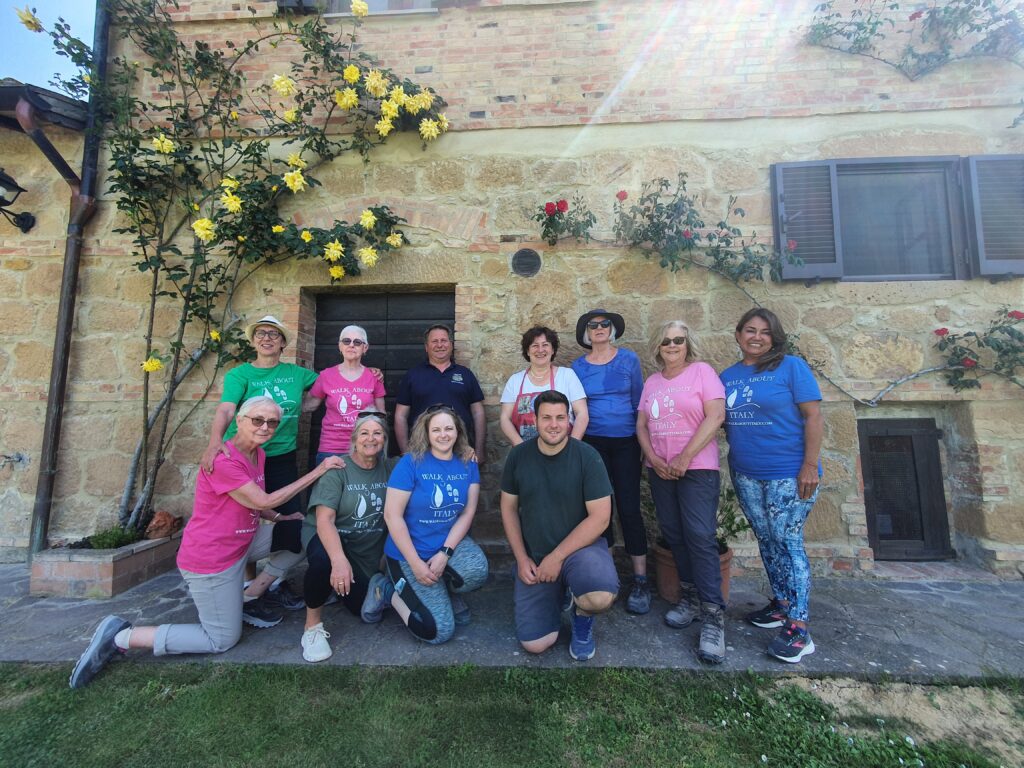
Podere Santa Maria lies in that beautiful stretch of countryside between Pienza and Monticchiello where the landscape can sometimes look almost too perfect to be real. Rolling fields follow the contours of the hills, cypress trees punctuate the skyline and old farmhouses appear here and there among cultivated land that has been worked for generations.
The scenery is certainly part of the pleasure of coming here, but it is not the reason Santa Maria has become such a special stop for us. The real reason is the family who lives and works here. Over many years, Maura, Virno and their family have become friends, and that personal relationship changes completely the character of our visits.
One of my happiest memories of Santa Maria actually has nothing to do with saffron. Some years ago, I organized a concert there with my own band, and it turned into one of those wonderful days that you remember long afterwards: music, friends, food and the Val d’Orcia all around us. It was informal, joyful and completely at home in the setting — exactly the kind of day that is almost impossible to reproduce deliberately.
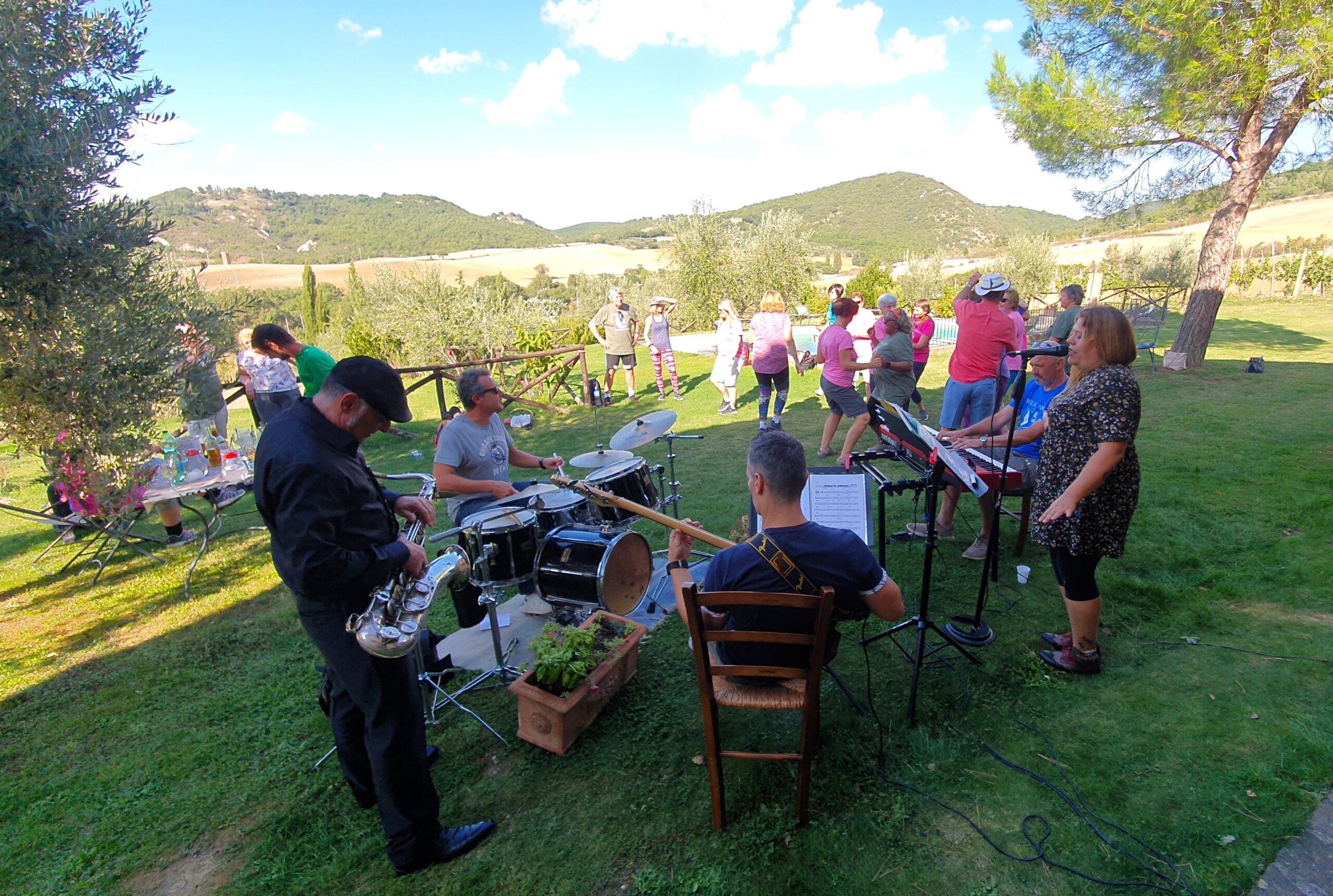
Memories like that are also why I never think of Santa Maria simply as one of the places we visit on a tour. It is somewhere where friendships have grown over time, where we have shared meals and celebrations, and where our relationship with the family existed long before a group of travelers sat down at the table.
Santa Maria does not normally operate as a restaurant open to outside visitors. Meals are principally prepared for the guests staying at the farmhouse, so the lunches Maura makes for Walk About Italy are not something that can simply be booked by anyone passing through the Val d’Orcia. She welcomes our groups because of the friendship and trust we have built over the years, and I think our guests can feel that difference almost immediately.
There are many places in Tuscany where you can book a tasting or a farm lunch, and some of them are excellent. But being welcomed somewhere because there is a genuine relationship behind the visit has a completely different feeling. It is less like arriving at an attraction and more like being invited into somebody’s world for a few hours.
A farm where the whole family is involved
Santa Maria is a genuinely family-run farm, not simply in name but in everyday life. Maura and Virno work alongside their children, with different generations contributing to the farm, the accommodation and the food that eventually appears on the table.
And then there is the grandmother. She still prepares the pici by hand, rolling those thick strands of traditional Tuscan pasta in the way they have been made in this part of Tuscany for generations. Watching her work is one of those apparently simple moments that can tell you more about a place than a long explanation ever could.
For visitors, handmade pasta has become almost an emblem of Italian food culture. Here, however, it is not a demonstration arranged for tourists. It is simply part of what this family does, with skills passing naturally from one generation to another.
That is one of the things I most enjoy about Santa Maria. You may arrive wanting to learn about saffron, but before long the conversation has expanded to pasta, olive oil, cereals, family recipes and whatever happens to be growing or being prepared that day. The farm makes sense as a whole, rather than as a collection of individual “experiences”.
How saffron grows
Saffron comes from Crocus sativus, an autumn-flowering plant belonging to the iris family. What is often casually called its bulb is technically a corm, an underground storage organ that allows the plant to survive its dormant period and regenerate.
For much of the hot Tuscan summer there is very little to see above ground. As the season changes, slender green leaves begin to emerge, followed by the flower buds. Then, usually during autumn, the violet or lilac flowers appear with their three unmistakable crimson stigmas.
Those three stigmas are the part that eventually becomes the spice we call saffron, which is worth remembering when you look at the size of a flower. There are only three threads to collect from each one, so the economics of saffron cultivation begin to make sense rather quickly.
The plant has a very long history in the Mediterranean world and beyond. Cultivated saffron has been grown for thousands of years, and today central Italy provides conditions well suited to it, with plenty of sun and soils where good drainage can be maintained.
From flower to spice: the autumn harvest of saffron in Tuscany

In our part of Tuscany, saffron normally flowers during the autumn, often around October and into early November, although agriculture never follows an exact calendar. Temperature, rainfall and the conditions of a particular year always have the final say.
When the flowers appear across the field, it is a beautiful sight, but the picturesque part of saffron cultivation is also the beginning of a very labor-intensive process. The flowers are collected by hand during their short flowering period and then opened individually so that the three stigmas can be carefully separated from the rest of the flower.
It is delicate, repetitive work, and there is really no shortcut. Once removed, the stigmas must then be dried correctly, both to preserve them and to develop the aroma and character we associate with good saffron.
Seeing this process completely changes the way you look at the spice. A small jar of saffron may seem expensive when you see it on a shop shelf; after watching how much work goes into producing it, you may start thinking it is rather reasonably priced.
Why saffron is so precious
Producing just one gram of dried saffron can require around 150 flowers. Each of those flowers has to grow, be picked and handled individually before its three stigmas are finally separated and dried.
That extraordinary ratio explains why saffron has historically been such a valuable product. What eventually fits into a tiny container represents a surprisingly large number of flowers and many hours of careful manual work.
Its intensity also means that very little is needed in cooking. Saffron contributes its characteristic golden color, a complex aroma and a gently bitter note that can work in dishes ranging from pasta and rice to sauces and desserts.
From a more scientific point of view, three groups of compounds play particularly important roles: crocins are mainly responsible for the color, picrocrocin contributes to the flavor and safranal is strongly associated with saffron’s distinctive aroma. I am a geologist rather than a chemist, however, so at this point I am usually quite happy to leave the molecules alone and move on to lunch.
Maura’s kitchen, her recipe book and a dessert with a story
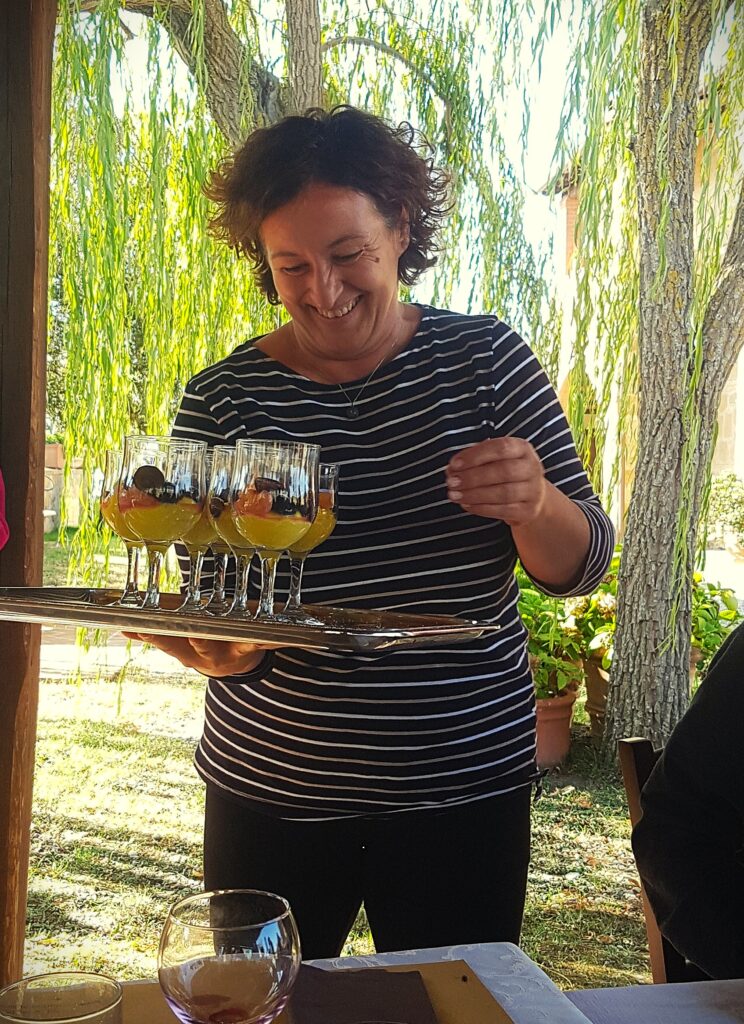
Maura is a wonderful cook, and what I like most about her food is that it feels completely connected to the farm around you. Cereals, legumes, olive oil and saffron are not ingredients brought in to construct a menu about Tuscany; they are part of the agricultural life of Santa Maria.
Over the years, Maura has collected her experience and many of these traditions in a beautiful recipe book “Quanto Basta” (it literally means “as much as is needed” and is commonly translated as “to taste” or “as needed,” especially in recipes) devoted to the dishes and flavors that belong to the farm and to this corner of the Val d’Orcia. It is a natural extension of the way she cooks: recipes are not separated from family, seasons and local produce, but are part of the same story.
I can even claim a very small contribution to the Santa Maria repertoire. Some years ago, I suggested to Maura that she should create a dessert using saffron. She took the idea, experimented with it and — fortunately for all of us — turned it into something delicious.
I would not go so far as to demand a place in the history of Italian gastronomy, but I do like reminding her that the original suggestion was mine.
Today, tasting that dessert with our guests is one of those small pleasures that has accumulated around years of friendship. An idea mentioned almost casually eventually became a dish, and the dish became part of the story we share with people who travel with us.
Saffron beer: the unexpected finale
And just when you think you have understood what saffron is supposed to be used for, Santa Maria introduces another possibility: beer.
The family produces barley as well as saffron, so combining the two is actually far more logical than it sounds at first. The result is a saffron beer that reflects the same philosophy as much of what happens at the farm — take what the land produces and find an interesting way to use it.
I particularly enjoy watching guests react when the beer is mentioned. Saffron in pasta makes sense, saffron in dessert becomes intriguing, but saffron beer usually produces a moment of genuine surprise.
That is often where the best travel memories hide: not necessarily in the famous things you expected to see, but in the small discoveries you never knew existed.
Discovering saffron on our Iconic Tuscany tour
Santa Maria is one of the family farms we visit during our Iconic Tuscany walking tour, according to the season and the agricultural calendar. The day takes us through the countryside around Pienza and Monticchiello, among some of the most recognizable landscapes of the Val d’Orcia, but the purpose is not simply to admire them from a distance.
We want our guests to understand something of the life behind that landscape. Depending on the season, that may mean discovering saffron at Santa Maria or visiting another local producer to learn about a different agricultural tradition. We deliberately allow the farming calendar to determine part of the experience rather than pretending that everything in the countryside happens twelve months a year.
Agriculture should not be staged for tourism. Saffron flowers when conditions tell it to flower, olives ripen when they are ready and the work of a farm changes continually with the seasons.
When we are at Santa Maria, however, what stays with me most is rarely a technical explanation about saffron. It is seeing Maura and Virno working with their children, the grandmother’s hands rolling pici, food arriving at a table reserved for us because of a friendship built over many years, and our guests gradually understanding that they have been allowed to see something more personal than a standard farm visit.
This, for me, is one of the great pleasures of travelling through Italy: not simply looking at beautiful places, but occasionally being invited into the life that gives those places their meaning.
And when those delicate purple saffron flowers begin pushing their way through the autumn earth, I still stop to look at them. They seem far too fragile to make it through that hard Tuscan soil, and yet every year they do.
Perhaps that is why they always make me smile.