
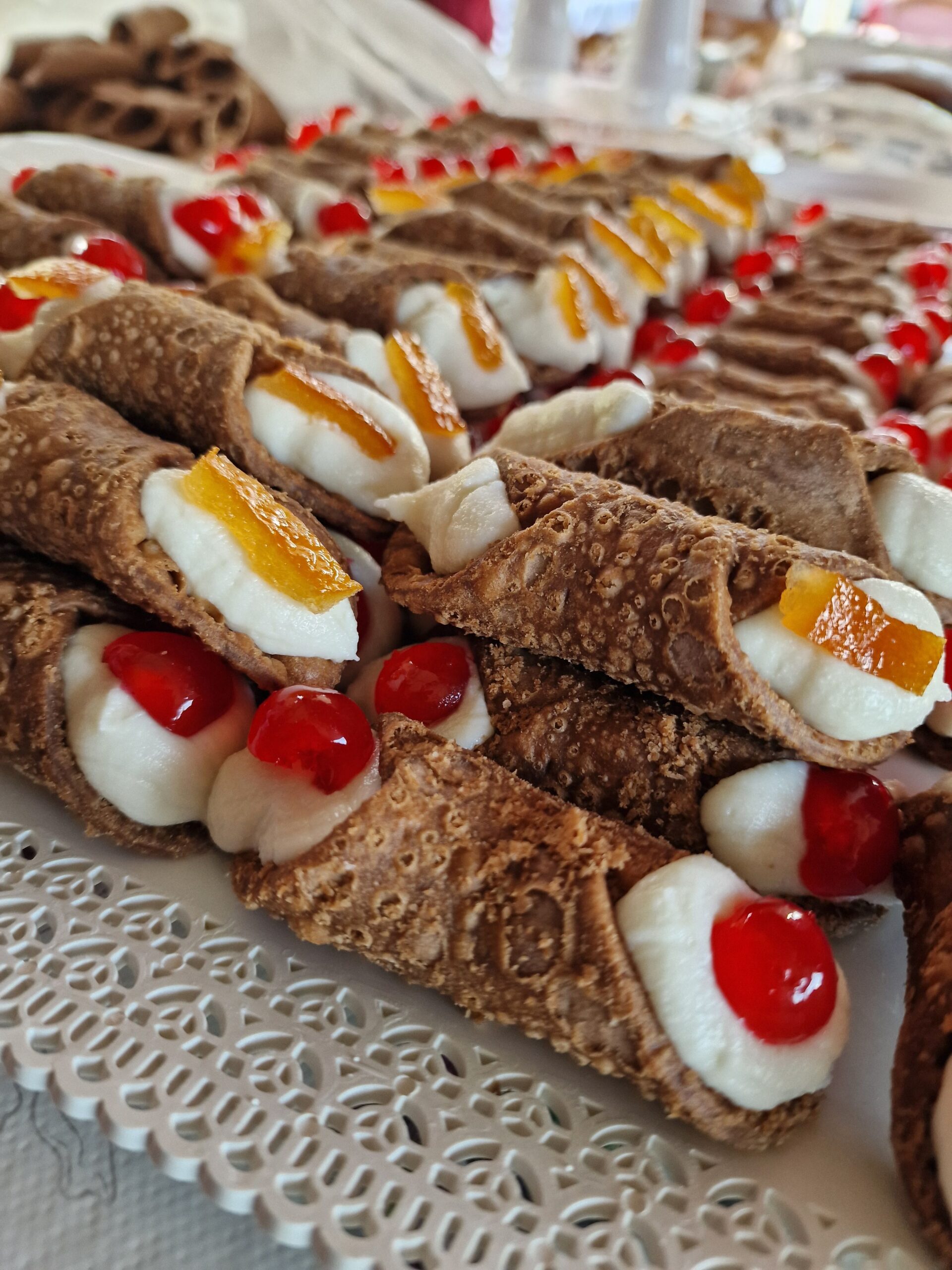
I challenge you to go to Sicily and not stop in a traditional pastry shop. Don’t even try. You will lose.
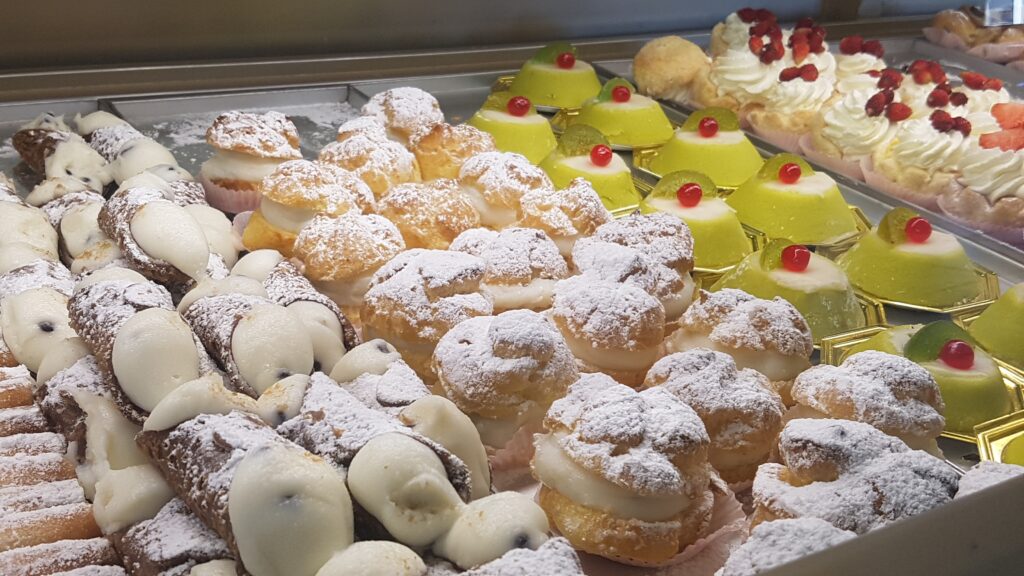
I often go to Sicily for work and pleasure, and over the years I have learned that resisting its pastry shops is largely pointless. There are simply too many temptations: cassata, granita, almond cookies, gelo di mellone — a wonderfully refreshing watermelon pudding — pistachio pastries, frutta martorana, those astonishing little fruits made from almond paste, and, of course, one of the masterpieces of Sicilian pastry: the Sicilian cannoli.
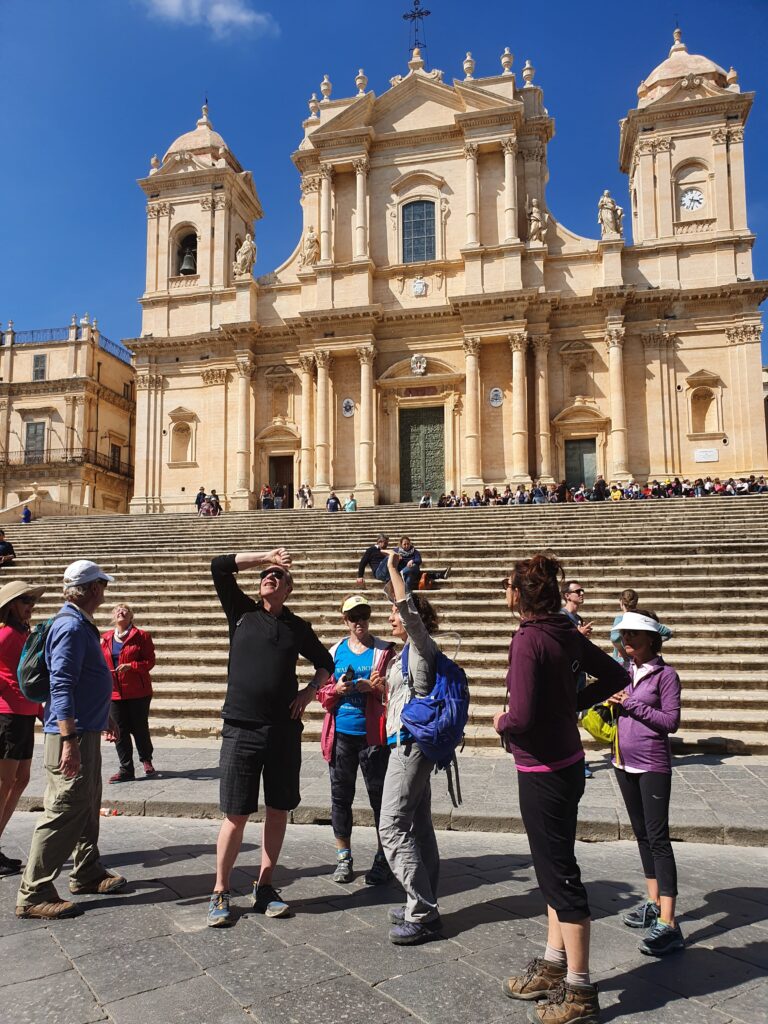
On our The Secret Side of Sicily tour, one of my favourite places to give in to temptation is Noto. After walking through its elegant Baroque streets, surrounded by palaces and churches built in that warm golden stone that seems to absorb the Sicilian light, there is another historic institution worth visiting: Caffè Sicilia, which has been part of the town since 1892.
It is famous for its pastries and particularly for its granita, but whenever cannoli appear on the counter, my impartiality disappears rather quickly.
In this article
- What Exactly Is a Cannolo?
- The Arab Origins of Sicily’s Most Famous Pastry
- The Legend of Caltanissetta
- Did Cicero Know About Cannoli in 75 BC?
- Where We Eat Cannoli on Our Sicily Tour
What Exactly Is a Cannolo?
First, a small lesson in Italian: one is a cannolo, while two or more are cannoli.
The traditional Sicilian cannoli are wonderfully simple. A thin tube of pastry is fried until crisp and then filled with sweetened sheep’s milk ricotta. The name is generally associated with the canne, or reeds, around which the pastry was traditionally rolled before frying; today metal cylinders have mostly taken their place, but the basic idea has changed very little.
What really matters is the contrast between the shell and the filling. A good cannolo should have a crisp, brittle exterior and a fresh, creamy ricotta filling that is sweet without becoming heavy. Depending on where you are in Sicily and who is making it, you may also find chocolate chips, pistachios, cinnamon, candied orange peel or cherries decorating the ends.
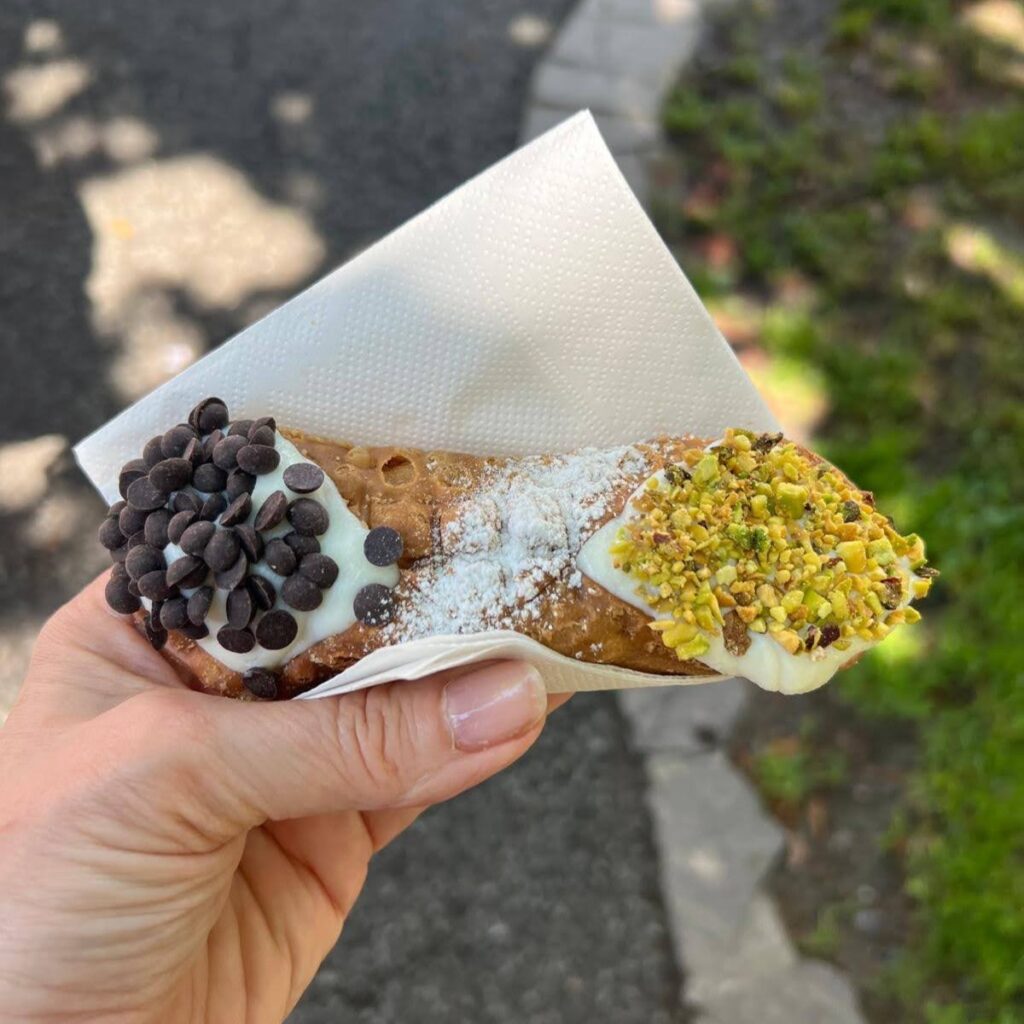
For me, this combination is what makes the cannolo so satisfying. The first bite breaks through the crunchy shell and immediately reaches the soft ricotta inside, creating a balance that is both simple and surprisingly rich. It is not an elaborate dessert in appearance, but very few things taste quite as complete.
The Arab Origins of Sicily’s Most Famous Pastry
The exact origins of the cannolo are uncertain, which is perhaps appropriate for a dessert born on an island whose culture has been shaped by so many different peoples. Greeks, Romans, Byzantines, Arabs, Normans and Spaniards all left something behind in Sicily, and the island’s food is one of the clearest places to see those layers still living together.
Arab rule, which began in the ninth century, had a particularly important influence on Sicilian agriculture and cooking. Sugar, almonds, citrus fruits, spices and new ways of combining ingredients became part of a culinary world that survived long after the political period itself had ended. Sicily already produced sheep’s milk ricotta, but the habit of working dairy products with sugar, candied fruit, nuts and aromatic flavours helped create the pastry tradition for which the island later became famous.
It would be too simple to say that the cannolo we eat today was invented in exactly the same form during Arab rule. Food traditions evolve slowly, with ingredients and techniques being adapted over generations. Yet the flavours of the cannolo clearly belong to that wider Mediterranean story, and that is one of the reasons Sicilian pastry is so interesting: eating it is also a way of reading the island’s history.
The Legend of Caltanissetta
The most famous story about the birth of the cannolo takes us to Caltanissetta, in central Sicily. The city’s name has Arabic origins and has traditionally been connected with Qal’at an-Nisa, often interpreted as “Castle of the Women”.
According to legend, during the period of Arab rule the women living in the harems of the Saracen emirs prepared elaborate sweets to pass the time and please their men. One of these creations is said to have been a fried pastry tube filled with sweetened ricotta — something very close, at least in imagination, to the ancestor of the modern cannolo.
Another tradition tells a rather different story. In this version, the cannoli were created or perfected by cloistered nuns in a convent near Caltanissetta. At first sight, the journey from an emir’s harem to a Christian convent may seem an unlikely one, but recipes often survive political and religious changes far better than institutions do.
Ingredients remain, techniques are passed on, and a dish can continue to evolve long after the world in which it first appeared has disappeared. That, at least, is one of the charming possibilities behind the story of the cannolo.
Did Cicero Know About Cannoli in 75 BC?
There is an even older story associated with Sicily’s most famous pastry. The Roman statesman and orator Cicero spent time on the island while serving as quaestor in Lilybaeum, today’s Marsala, in the first century BC.
A phrase traditionally attributed to him describes a “tubus farinarius dulcissimo edulio ex lacte fartus”: roughly, a tube made of flour filled with an extremely sweet milk-based food. It certainly sounds familiar, and for generations the description has been repeated as an intriguing possible ancestor of the cannolo.
We should be cautious, however, about turning a resemblance into a certainty. The modern Sicilian cannolo belongs to a much later culinary tradition, and we cannot draw a direct historical line from Roman Sicily to the pastry served in Noto today. Still, the story is irresistible because it reflects something very true about Sicily itself: behind almost every recipe there seems to be another layer of history waiting to be discovered.
Where We Eat Cannoli on Our Sicily Tour
Food is not something we simply add to our tours because, sooner or later, everyone needs to eat. For us, it is part of understanding a place, just as much as walking through its landscapes, entering its churches or listening to the stories of the people who live there.
You can learn a great deal about Sicily by walking through the Vendicari Nature Reserve, exploring the Baroque streets of Noto or looking down into the crater landscape of Vulcano. But you understand something different when you sit down in a café and taste what generations of Sicilians have created from ricotta, almonds, citrus fruits, pistachios and sugar. Those flavours are not separate from the island’s history; they are another expression of it.
That is why places such as Caffè Sicilia in Noto matter to me when we travel through the island. The café has been there since 1892, and after spending time exploring the town, stepping inside gives the day another dimension. There is granita, there are pastries, and, of course, there are cannoli — all part of a tradition that feels completely at home in the streets around you.
Usually someone in the group says they will have “just a taste”. I have heard this many times.
It rarely goes according to plan.
And perhaps that is exactly as it should be. Travelling through Sicily without tasting its pastry would mean missing part of the island itself, because food here is not simply something delicious encountered along the way. It carries memories, migrations, ingredients and stories that have been accumulating for centuries.
Tasting Sicilian pastry is, in its own way, a journey through history.
And I have to admit: I love our sweet history.