
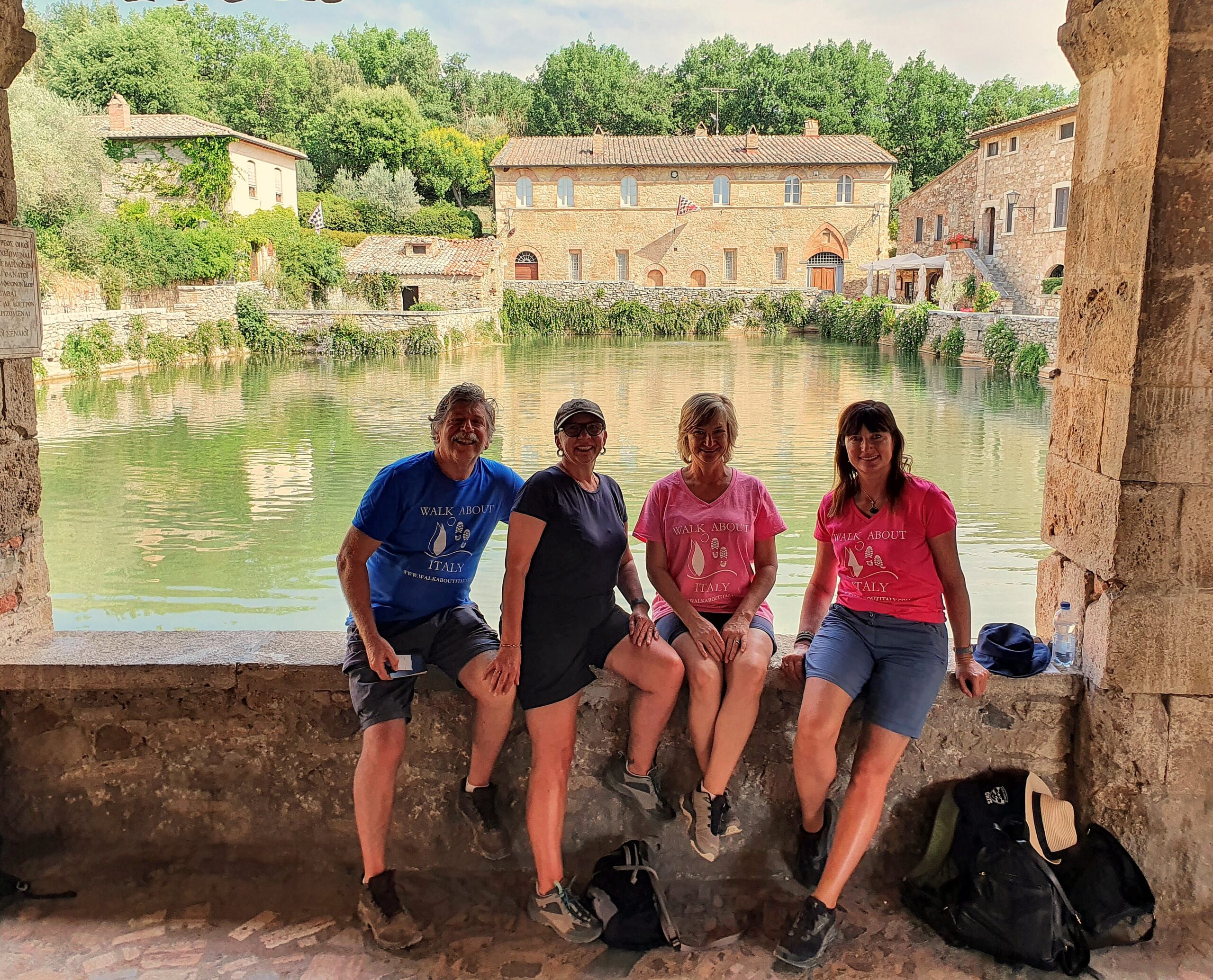
There are many beautiful villages in Tuscany, but Bagno Vignoni is unlike any other. You arrive expecting the familiar ingredients of a Tuscan hill town — stone houses, narrow streets, perhaps a small piazza — and instead find yourself standing in front of a large rectangular pool of steaming thermal water occupying the very heart of the village.
I come here regularly during the year, and Bagno Vignoni is also one of the places we visit on our Iconic Tuscany walking tour, yet it still manages to surprise me. Perhaps that is partly because I am a geologist. Here, geology is not something hidden beneath the landscape: you can see it in the water, in the pale travertine, in the shape of the hillside and even in the way people have lived and worked here for centuries.
Some years ago, my colleague Sara and I organized a walk around Bagno Vignoni. Sara is an anthropologist, while I naturally tend to look at the rocks beneath our feet, and walking together through the village and the nearby Valley of the Mills gave us two different but complementary ways of reading the same landscape. Mine began with water and stone; hers with the people who learned how to make use of them.
A Tuscan village built around hot springs
The center of Bagno Vignoni is Piazza delle Sorgenti, but calling it a piazza can initially be a little misleading. Instead of a paved square, you find a large sixteenth-century basin filled with thermal water rising from underground at around 49–50°C (120–122°F). Stone buildings surround it, and on cooler days steam drifts across the surface, giving the village an atmosphere that is difficult to find anywhere else in Tuscany.
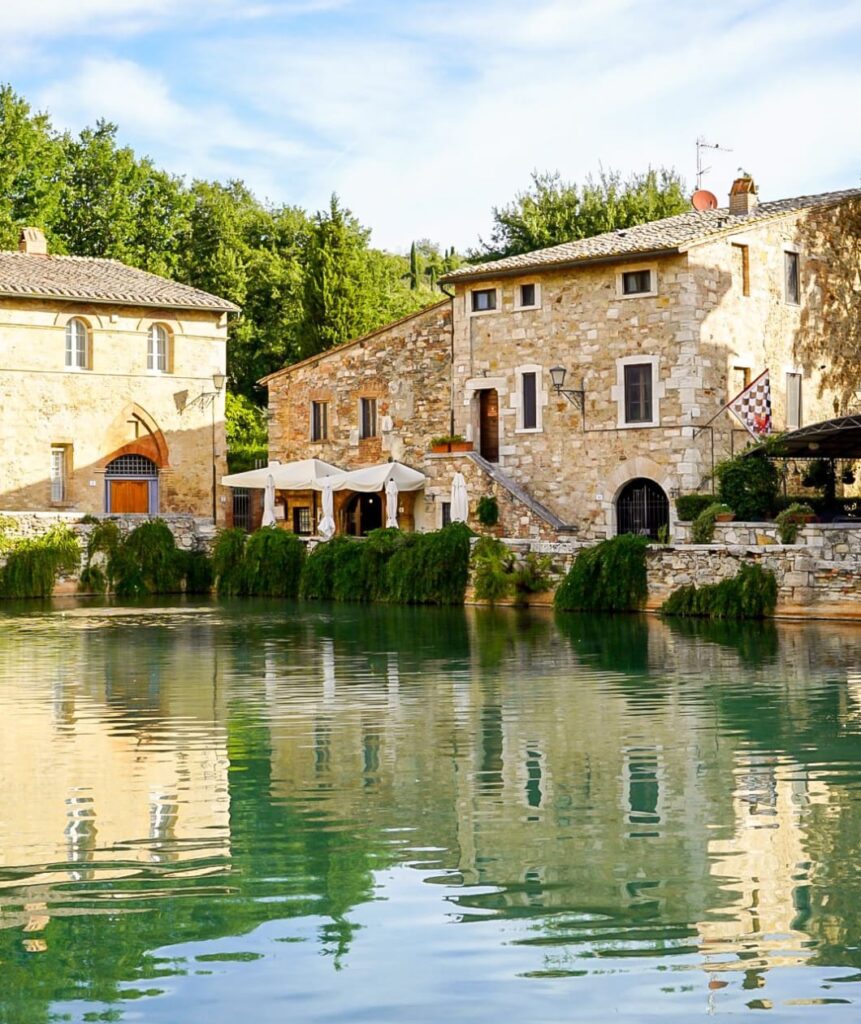
The hot springs, however, are much older than the pool we see today. The water was already being used in Etruscan and Roman times, while Bagno Vignoni later became an important stopping place thanks in part to its proximity to the Via Francigena, the great pilgrimage route crossing this part of Tuscany. Over the centuries the baths attracted some rather distinguished visitors too, including Saint Catherine of Siena and Lorenzo de’ Medici.
You can no longer bathe in the historic pool itself, but that hardly diminishes its appeal. Apparently, even Bagno Vignoni’s strictly off-limits pool could not resist Italy’s 2006 World Cup celebrations. After Italy won the final in Berlin, the celebrations are said to have reached even this normally untouchable corner of the Val d’Orcia, with some very enthusiastic supporters ending up in the pool.
There is another time when this tiny village becomes unexpectedly crowded, although for a rather more intellectual reason. Every September, Bagno Vignoni hosts I Colori del Libro, an annual literary festival dedicated especially to independent and small publishing. Writers, journalists, publishers and personalities from the Italian cultural world arrive in the village, together with a remarkable number of visitors. For a weekend, this wonderfully small place fills with books, talks, presentations and people moving between the stalls and the thermal pool. I have always liked the contrast: a handful of stone streets in the Val d’Orcia suddenly becoming a lively meeting place for authors and readers.
And then, when the crowds disappear, Bagno Vignoni becomes a tiny village built around something apparently very simple: water continuously emerging from the earth.
The geology beneath Bagno Vignoni
Of course, this is the part where I become particularly interested.
Thermal water begins its journey long before it appears in the middle of the village. Rainwater infiltrates underground and circulates deep through the rocks, where it is heated before eventually rising again along fractures and faults. During this long underground journey it interacts with the surrounding rocks and becomes rich in dissolved minerals, particularly calcium carbonate.
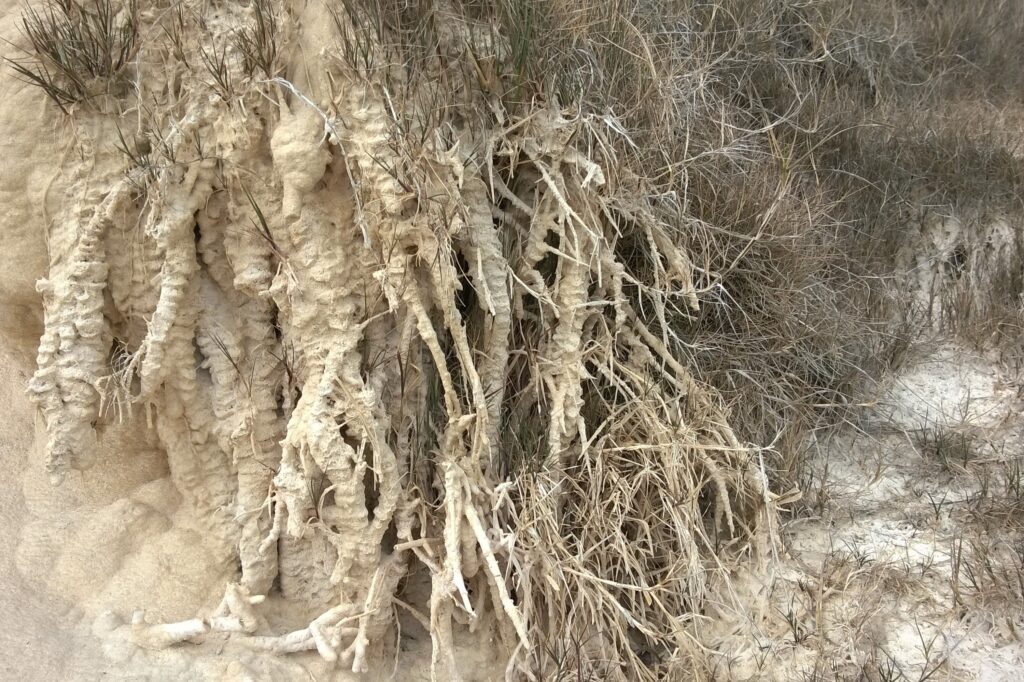
When the water reaches the surface, physical and chemical conditions change and part of that calcium carbonate begins to precipitate. Slowly, layer after layer, it creates travertine, the pale limestone so characteristic of Bagno Vignoni and particularly easy to see as you walk down from the village towards the Valley of the Mills.
Travertine was not only forming naturally beneath the village: for centuries it was also quarried here as a building stone. The quarries around Bagno Vignoni have a long history, and although the old quarrying areas are now abandoned, their great exposed faces are still clearly visible in the landscape. The stone extracted from this area was used in buildings throughout the surrounding territory, another reminder that geology here has never simply provided the scenery — it has also supplied the raw materials people used to build and shape their world.
What I love about places like this is that the geology is visible even to someone who has never studied it. Once you know what you are looking at, the landscape starts telling its own story. Those white and cream-coloured deposits are not simply attractive rocks along a path: they are the result of the same thermal system that is still active today.
For a geologist, old travertine deposits are a little like pages in a book. They record the interaction between water, rock, temperature and time — processes that began long before us and continue while we stand there looking at them.
And yes, this is usually the moment during a walk when I probably start talking a little too enthusiastically about geology.
The Valley of the Mills: when water became energy
But the story of Bagno Vignoni is not only geological, and this is where Sara’s anthropologist’s eye adds another layer.
The people who lived here did not simply appreciate the thermal spring for bathing. They learned to exploit its constant flow as a source of energy. Water leaving the main pool was directed down the steep slope beneath the village through a sophisticated system of channels towards a group of mills, some of them largely excavated into the travertine rock.
Today the area is known as the Parco dei Mulini, the Park of the Mills, and walking through it makes the relationship between geology and human ingenuity particularly clear.
Traditional watermills elsewhere depended on rivers and streams whose flow could vary considerably during the year. In Tuscany, dry summers could mean less water and therefore less power. Bagno Vignoni had a remarkable advantage: the thermal spring kept flowing throughout the year, allowing the mills to continue working even when other watercourses were running low.
As you walk farther down, beyond the old mills, the view opens onto the valley below. There flows the Orcia River, and this is where Sara has a story that completely changes the landscape you are looking at.
“Now look at the Orcia down there and try to imagine this whole valley as a lake. It sounds a little crazy, but Pope Pius II really did think about it! He even wrote about the idea in his Commentarii: dam the Orcia near Bagno Vignoni, divert the Vivo River into it and create a huge artificial lake. And what do you do with your brand-new lake? Fill it with fish, of course! There was a defensive purpose too, so it wasn’t entirely about giving the Pope somewhere nice to go fishing. The problem was that it was an enormously ambitious — and expensive — project. Pius himself admitted that it was the sort of undertaking suited to a pope who was at peace and free from the worries of war, and his final years turned out to be anything but peaceful. He became increasingly occupied with organizing a crusade against the Ottomans and died in 1464 before any of it could happen. So when you look down at the Val d’Orcia today, just imagine: if Pius II had had a little more time and a lot more money, we might be standing here looking at a lake!” — Sara
It is one of those stories that makes you look at a familiar landscape differently. The Val d’Orcia seems so timeless today that it is strange to imagine a Renaissance pope seriously considering filling part of it with water.
And that is what I find so fascinating about Bagno Vignoni: everything connects. The underground geology creates the thermal spring; the spring deposits the travertine; people quarry that travertine, carve mills into it and use the flowing water to produce energy. Then a pope looks at the same river and starts imagining a lake.
Rock, water and human history become parts of the same story.
Walking from Bagno Vignoni into the Val d’Orcia
Today Bagno Vignoni is one of the stops on our Iconic Tuscany walking tour, and it is also a good example of why I have always thought that walking is one of the best ways to understand this part of Italy.
We spend time exploring the village and the thermal springs before continuing on foot through the Val d’Orcia towards San Quirico d’Orcia. It is a beautiful walk, of course, but beauty is only part of what makes it interesting. Once you know something about the geology beneath your feet, the water emerging from the ground and the people who have adapted to this landscape over the centuries, you begin to look at everything differently.
That has always been one of my favorite aspects of guiding. People arrive with different interests and notice different things, and their questions often lead the walk in directions I had not expected. A hot pool becomes the beginning of a geological story. A white rock becomes travertine. An abandoned mill opens a window onto the economy of a village centuries ago. Even the quiet Orcia flowing below us becomes the lake that Pope Pius II once imagined.
Years after that walk with Sara, this is still what Bagno Vignoni represents to me. Of course I love the landscape, the history and, being a geologist, the rocks. But what I enjoy most is having the opportunity to walk through a place like this with other people and share what makes it special.
That is the ordinary happiness my work gives me: walking through a beautiful place, understanding a little more about it, and having someone there to share the discovery with.