
There is a moment during a visit to Pompeii when the ancient city suddenly stops feeling ancient. Until then, you have been walking along Roman streets, entering houses and public buildings, looking at frescoes, fountains and shops. You begin to notice the grooves worn into the stone by carts, the raised stepping stones that allowed people to cross the streets and the many small details that gradually reconstruct everyday life almost two thousand years ago.
It is fascinating, but there is still a certain distance between you and the people who once lived here. Then you see the casts.
Whenever we visit Pompeii during our Amalfi Coast Walking Tour, I often find myself watching our guests’ reactions. At first there is usually shock, sometimes even horror. Then people become quiet, and little by little that first emotional response gives way to something else: the attempt to imagine.
Who was this person? Where were they going? Were they alone? Did they understand what was happening around them?
This is what makes the Pompeii casts so extraordinary. They do something that buildings, mosaics and archaeological objects rarely manage to do: they bring us face to face with individual human beings, not with Roman history in general, but with particular people caught in one of the most dramatic moments of the ancient world.
What you feel standing in front of the Pompeii casts
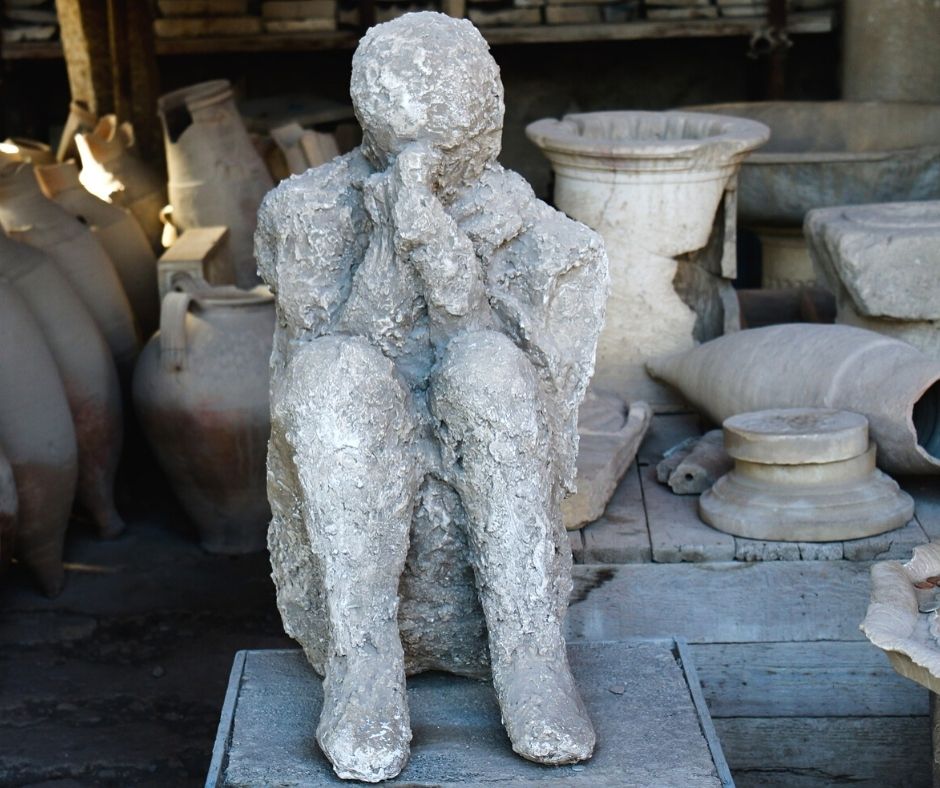
The plaster casts of Pompeii are not sculptures, and nobody arranged their gestures or expressions for artistic effect. They exist because, after the eruption of Mount Vesuvius in AD 79, bodies buried beneath volcanic material eventually decomposed, leaving empty spaces inside the hardened deposits. Centuries later, archaeologists discovered that these cavities still retained the shape of what had once been there.
When plaster was poured into them, human forms reappeared.
A bent leg, an arm drawn toward the face, a body curled inward, the texture of clothing or the outline of footwear: these details suddenly make the people of Pompeii feel extraordinarily close. You can admire a Roman mosaic intellectually or study the architecture of a domus, but the casts from Pompeii affect visitors in a very different way.
Almost two thousand years separate us from the people who died here, yet fear, uncertainty, vulnerability and the instinct to protect ourselves need no explanation. The casts shorten that distance immediately, and this is why many visitors remember them long after they have left the archaeological site.
What happened in Pompeii in AD 79?
To understand the casts, we first have to understand the catastrophe that created the conditions for their preservation. Mount Vesuvius erupted in AD 79, years after Pompeii had already suffered a major earthquake. Some buildings were still being repaired when the eruption began, but the inhabitants had neither our modern scientific understanding of volcanoes nor the instruments that today allow us to monitor volcanic activity.
The eruption sent an enormous column of volcanic material high above Vesuvius, while ash, pumice and small volcanic fragments began falling over the city. For hours, this material accumulated on streets, courtyards and rooftops. Roofs became increasingly unstable under the weight, moving through the city became more difficult and escape routes were gradually obstructed.
Some inhabitants managed to leave the city, while others stayed behind. Perhaps they thought their homes would protect them, perhaps they were waiting for relatives, or perhaps they simply did not understand how serious the situation had become. We cannot know for certain.
Later, pyroclastic currents — dense, fast-moving clouds of hot gas, ash and volcanic particles — swept through the area. For those who had remained in Pompeii, there was little possibility of survival. The city was eventually buried beneath metres of volcanic deposits.
It was a catastrophe, but it also created one of archaeology’s great paradoxes: the same eruption that destroyed Pompeii also helped preserve it. Buildings, streets, paintings, household objects and countless details of daily Roman life survived beneath the volcanic material, together with something even more unexpected — the empty spaces left by some of the victims.
The plaster cast technique — Giuseppe Fiorelli
The Pompeii body casts that we see today are closely associated with the work of the Italian archaeologist Giuseppe Fiorelli. During nineteenth-century excavations, archaeologists occasionally encountered strange cavities inside the compact layers of volcanic material. These voids had formed when organic material — wood, plants, animals or human bodies — decomposed after being buried.
The surrounding volcanic deposit had hardened first, so the object itself disappeared while its shape remained. In effect, the ash had created a natural mold.
In 1863, Fiorelli developed an ingenious method for recovering those missing forms. Liquid plaster was carefully poured into the cavities and allowed to harden. Archaeologists then removed the surrounding volcanic material, revealing the shape that had been lost.
The technique could reproduce wooden objects, plant roots and animals, but the human casts transformed the way Pompeii was understood and experienced. They sometimes preserved remarkably small details, including folds of fabric, footwear, objects carried by the victims and elements of their physical appearance.
Fiorelli had found a way of excavating something that was no longer there. In a sense, he recovered an absence.
What the casts tell us
Archaeology usually reconstructs people through the things they leave behind. At Pompeii, we can enter houses, see where people cooked and ate, visit bakeries and workshops and look at thermopolia, the small food counters often described today as the fast-food establishments of the Roman world. We can read graffiti, walk through public buildings, visit baths and begin to understand how the city functioned.
The Pompeii cast bodies tell us something different. They preserve human gestures.

One of the casts our local guide Giovanna draws particular attention to during our visits is commonly referred to as the muleteer. The figure has his hands raised toward his face and, to a modern visitor, the gesture looks almost instinctive, as though he were trying to protect his nose and mouth from the ash and toxic atmosphere around him.
We cannot know exactly what he was thinking, and that distinction matters. It is very easy to invent stories when looking at the casts, to attach emotions to a position or to imagine relationships between figures. Sometimes those interpretations may be plausible, but archaeology also teaches us to respect what we do not know.
The power of the muleteer lies precisely there. We know very little about him, yet the gesture needs almost no translation.
The nineteenth-century Italian writer Luigi Settembrini, a contemporary of Fiorelli, understood this emotional power from the beginning. Writing about some of the first casts, he observed:
“It is impossible to see those three deformed figures, and not feel moved. They have been dead for eighteen centuries, but they are human creatures who see themselves in their agony. There it is not art, it is not imitation; but it is their bones, the relics of their flesh and their clothes mixed with plaster: it is the pain of death that regains body and figure … Up to now temples, houses and other objects have been discovered that interest the curiosity of educated people, artists and archaeologists; but now you, my Fiorelli, have discovered human pain, and anyone who is a man feels it.”
Those last words still explain remarkably well why the casts are so powerful today. Pompeii gives us an extraordinary picture of Roman civilization, but the casts remind us that civilization is always made of individual people.
Walking through Pompeii with Giovanna
One of the things we enjoy most about visiting Pompeii is that no two visits are exactly the same. Our route can vary depending on where we enter the archaeological site, what is accessible that day and the time available.
Sometimes we begin near Piazza Esedra, where the visit may include the Gladiators’ Barracks, the Small Theatre, a frescoed domus and a thermopolium. When time allows, the route can also include the ancient baths or the famous Lupanar.
At other times we enter through Porta Marina Superiore, the ancient gateway for those arriving from the sea. From there, the route may include the Basilica, one of the city’s most important civic buildings, the Temple of Apollo, a bakery and other traces of everyday life.
The real pleasure of Pompeii, however, often lies between the famous monuments. Giovanna stops the group to point out the grooves left by carts, the raised stepping stones, the public fountains, the construction techniques and all those details that would be easy to miss if you were simply moving from one major attraction to another.
Eventually we reach the Forum, the civic and religious heart of the city. With Vesuvius rising behind the ruins, it is one of the most memorable views in Pompeii. Nearby, in the ancient market area, there are three plaster casts, including the muleteer.
This is often the moment when the tone of the visit changes. The city we have been reconstructing through streets, shops, houses and public buildings suddenly acquires a human presence.
Visiting Pompeii on our Amalfi Coast Walking Tour
Pompeii is part of our Amalfi Coast Walking Tour because we believe you cannot fully understand the Bay of Naples and the landscape around Vesuvius without understanding the people who have lived here.
Our tours are based on walking, but walking for us is never simply about covering kilometers. It is a way of slowing down enough to notice things, and Pompeii is a perfect example of that approach.
A street becomes a Roman street because Giovanna explains the cart tracks. A group of stones becomes a pedestrian crossing. A counter becomes a place where somebody stopped for food. A building becomes somebody’s home.

As Giovanna says:
“Walk About Italy guests become particularly fascinated by Pompeii. They are always active and engaged throughout the tour, asking lots of questions and showing genuine curiosity. I have to say, we always have a really wonderful tour together!”
That curiosity changes the visit. There is always another question, another story or another detail that makes us stop and look more carefully.
And then there are the casts.
Every time I watch our guests standing in front of them, I recognize the same progression: first shock, then silence, then curiosity and finally empathy. People begin trying to imagine what it meant to be in Pompeii on that day in AD 79.
Perhaps this is Giuseppe Fiorelli’s greatest achievement. His technique did more than reveal the physical forms of some of the victims of Pompeii.
Almost two thousand years later, it allows us to meet them.